
A New Layer of
Human Awareness.
________
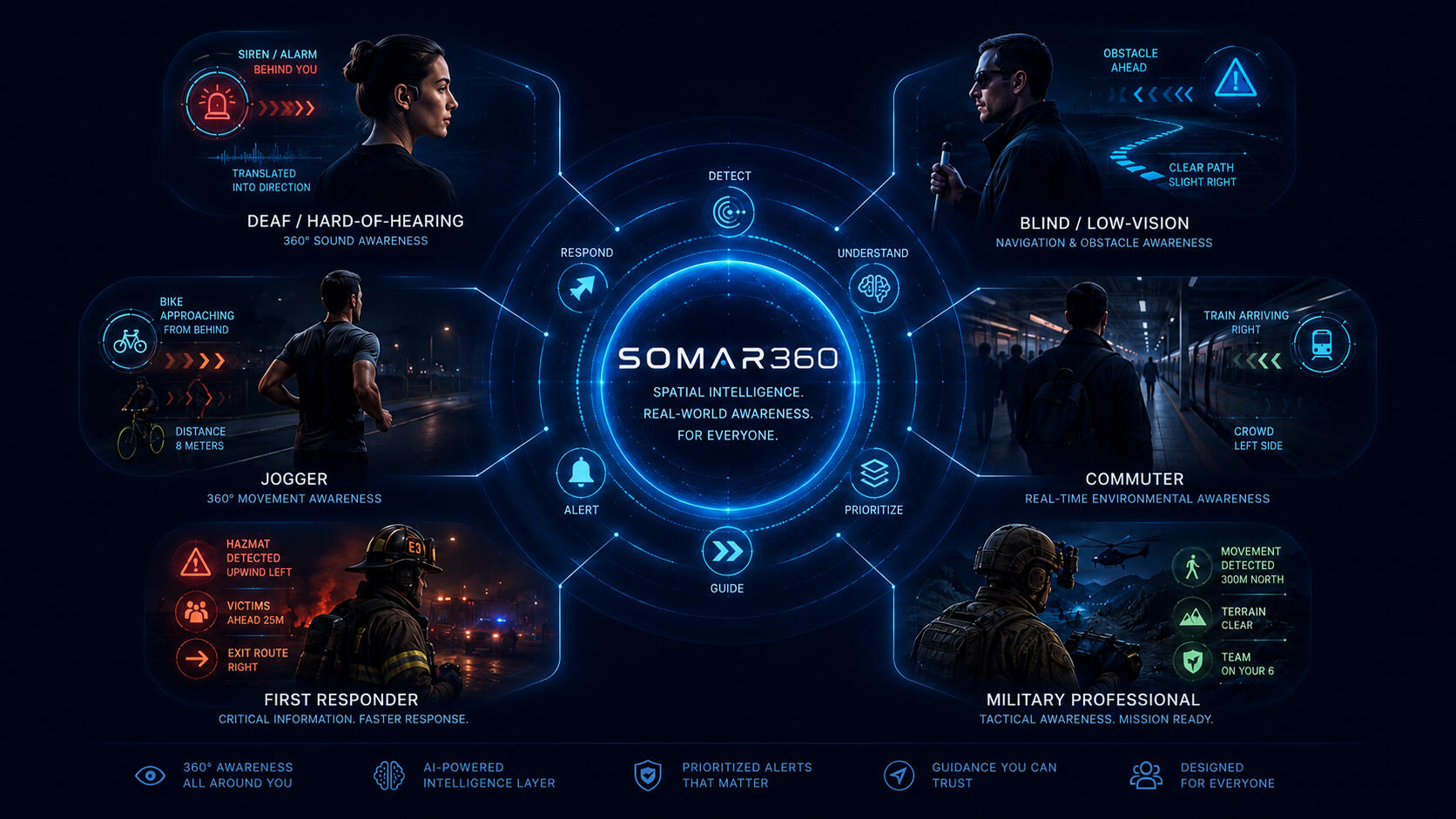
Somar360 is building spatial and situational intelligence that helps people understand what's happening around them, where it is happening, what matters, and how to respond.

JOIN SOMAR360
Help shape what Somar360 becomes
Join our community to stay updated, participate in future research and testing, and explore ways to collaborate.
What is Somar360?
Somar360 is a personal spatial intelligence platform being built to help people understand what is happening around them, where it is happening, whether it matters, and how to respond.Every moment, the physical world produces information.A vehicle approaches from behind.
Someone calls for your attention.
An alarm sounds across a room.
A person moves into your path.
A navigation turn is approaching.
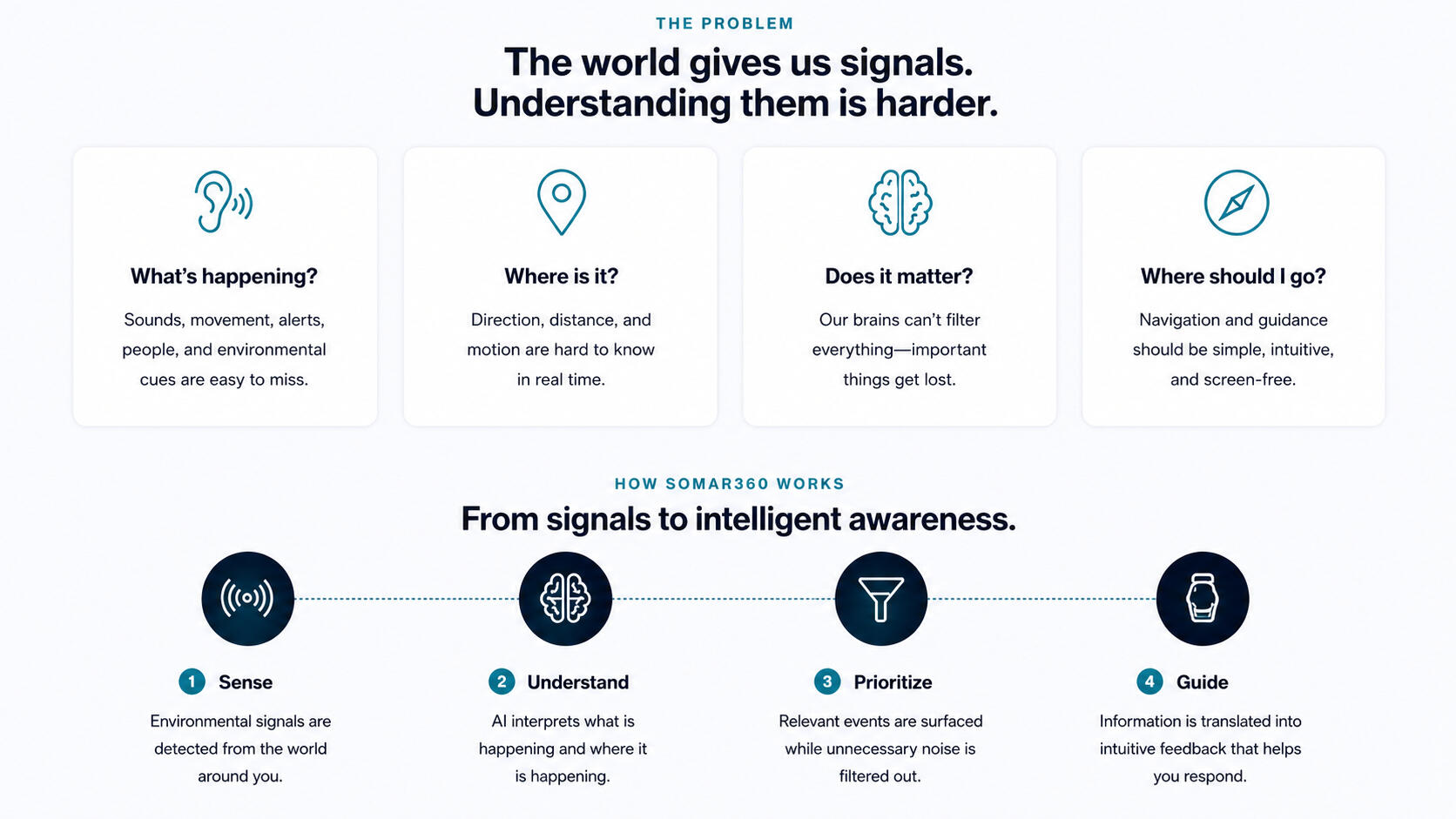
Something changes in the environment that may deserve your attention.Humans constantly process these signals through sight, hearing, movement, memory, attention and instinct. But our ability to perceive and interpret everything around us is limited.Sometimes information is missed.Sometimes the environment is too noisy.Sometimes our attention is somewhere else.Sometimes we are wearing headphones, looking at a screen, navigating an unfamiliar place, working in a demanding environment or simply unable to perceive a particular signal clearly.Somar360 is being created around a larger question:What if technology could intelligently interpret the physical world around a person and communicate the information that matters most without requiring them to constantly look at another screen?That is the idea behind Somar360.It is not simply a wearable notification device.It is being designed as an intelligence layer between humans and the physical environment.
Turning the Physical World Into Understandable Information
Most technology waits for people to interact with it.We open an app.We look at a map.We read a notification.We check a camera.We listen for an alert.Somar360 is exploring a different relationship between people and technology.Instead of requiring the user to continuously search for information, Somar360 is being designed to help recognize meaningful information in the environment and bring the right information to the person's attention.The long-term platform combines several layers of technology:Environmental sensing to gather information about what is occurring around the user.Artificial intelligence to help interpret what those signals mean.Spatial intelligence to understand where something is happening relative to the person.Prioritization intelligence to determine which events actually deserve attention.Haptic communication to translate that information into intuitive physical cues the user can feel.Together, these components are intended to transform raw environmental information into something personally meaningful.
Detect. Understand. Prioritize. Respond
Somar360 is being designed around four core functions.DetectThe first step is recognizing meaningful activity in the surrounding environment.Depending on the stage of development and future hardware configuration, Somar360 could eventually recognize information such as:environmental sounds
alarms and warnings
vehicles
approaching or retreating movement
people
obstacles
direction
proximity
navigation information
changes in the surrounding environmentThe objective is not to capture everything simply because it can be detected.The objective is to identify information that may actually matter to the person.UnderstandDetection alone is not intelligence.A system might recognize a sound, but the more important questions are:What is it?Where is it coming from?Is it approaching or moving away?Is it relevant to the user?Does the user need to know about it now?Artificial intelligence becomes an important part of Somar360 because the platform is intended to move beyond simple sensor alerts.The long-term goal is for the system to interpret context.For example, recognizing a vehicle somewhere nearby is useful.Understanding that the vehicle is approaching from behind is much more useful.Recognizing that a sound occurred is useful.Understanding that it is an urgent alarm coming from the user's left provides far more actionable information.Somar360 is being designed around that distinction.Prioritize What MattersA wearable that alerts the user about everything would quickly become overwhelming.The world is full of movement, sound and activity.That is why one of the most important parts of Somar360's long-term architecture is prioritization.The system is intended to help distinguish meaningful information from background noise.Not every sound deserves an alert.Not every person nearby matters.Not every object requires attention.Not every environmental event has the same urgency.Somar360's intelligence layer is intended to evaluate information based on factors such as context, direction, proximity, urgency, environment and eventually the user's individual preferences.The goal is not more notifications.The goal is better awareness.Respond Through a New Language of TouchOnce Somar360 understands that something deserves attention, the next challenge is communicating it.Most modern technology relies heavily on two interfaces:screens and sound.Somar360 is exploring another interface:touch.Through wearable haptic feedback, important environmental information could be translated into physical patterns that the user learns to understand intuitively.A signal originating from the left should not feel identical to something approaching from behind.A navigation instruction should not feel identical to an urgent warning.A nearby object should not necessarily communicate the same information as something rapidly approaching.The long-term goal is to develop a haptic language capable of communicating different types of spatial information through distinct physical patterns.Instead of simply:buzz = notificationSomar360 is working toward:pattern = meaning.That distinction is fundamental to the vision.
Somar360 is a personal spatial intelligence platform being built to help people understand what is happening around them, where it is happening, whether it matters, and how to respond.Every moment, the physical world produces information.A vehicle approaches from behind.
Someone calls for your attention.
An alarm sounds across a room.
A person moves into your path.
A navigation turn is approaching.
Something changes in the environment that may deserve your attention.Humans constantly process these signals through sight, hearing, movement, memory, attention and instinct. But our ability to perceive and interpret everything around us is limited.Sometimes information is missed.Sometimes the environment is too noisy.Sometimes our attention is somewhere else.Sometimes we are wearing headphones, looking at a screen, navigating an unfamiliar place, working in a demanding environment or simply unable to perceive a particular signal clearly.Somar360 is being created around a larger question:What if technology could intelligently interpret the physical world around a person and communicate the information that matters most without requiring them to constantly look at another screen?That is the idea behind Somar360.It is not simply a wearable notification device.It is being designed as an intelligence layer between humans and the physical environment.
What Could This Feel Like in the Real World?
Imagine walking through a busy city while listening to music.You do not have to continuously turn around to check what is behind you.Your wearable detects an approaching vehicle or cyclist and communicates its direction through a recognizable haptic pattern.Imagine navigating somewhere unfamiliar.Instead of repeatedly looking down at your phone, directional cues help guide you through touch.Imagine working in a loud environment.An important warning occurs behind you.Rather than depending exclusively on hearing or a visual display, the system provides another channel of awareness.Imagine crossing a complex public environment where several events are happening simultaneously.Rather than presenting every possible signal, Somar360 helps determine which one deserves your attention first.These examples illustrate the broader idea:technology should not simply provide more information. It should help humans understand the information already surrounding them.
Personalization Matters
Human awareness is not one-size-fits-all.Different people care about different information.Different environments create different risks.Different users may want different levels of sensitivity.A commuter may use Somar360 differently from a runner.A person navigating with hearing loss may have different priorities from someone using the platform for situational awareness at work.A first responder may require completely different information from an everyday consumer.That is why personalization is intended to become a core part of Somar360.Over time, users could potentially customize factors such as:which events deserve alerts
sensitivity levels
preferred haptic patterns
environmental modes
accessibility preferences
navigation behavior
urgency thresholds
individual situational needsThe vision is not for every user to experience Somar360 identically.The vision is for the intelligence to adapt to the person.
More Than One Wearable
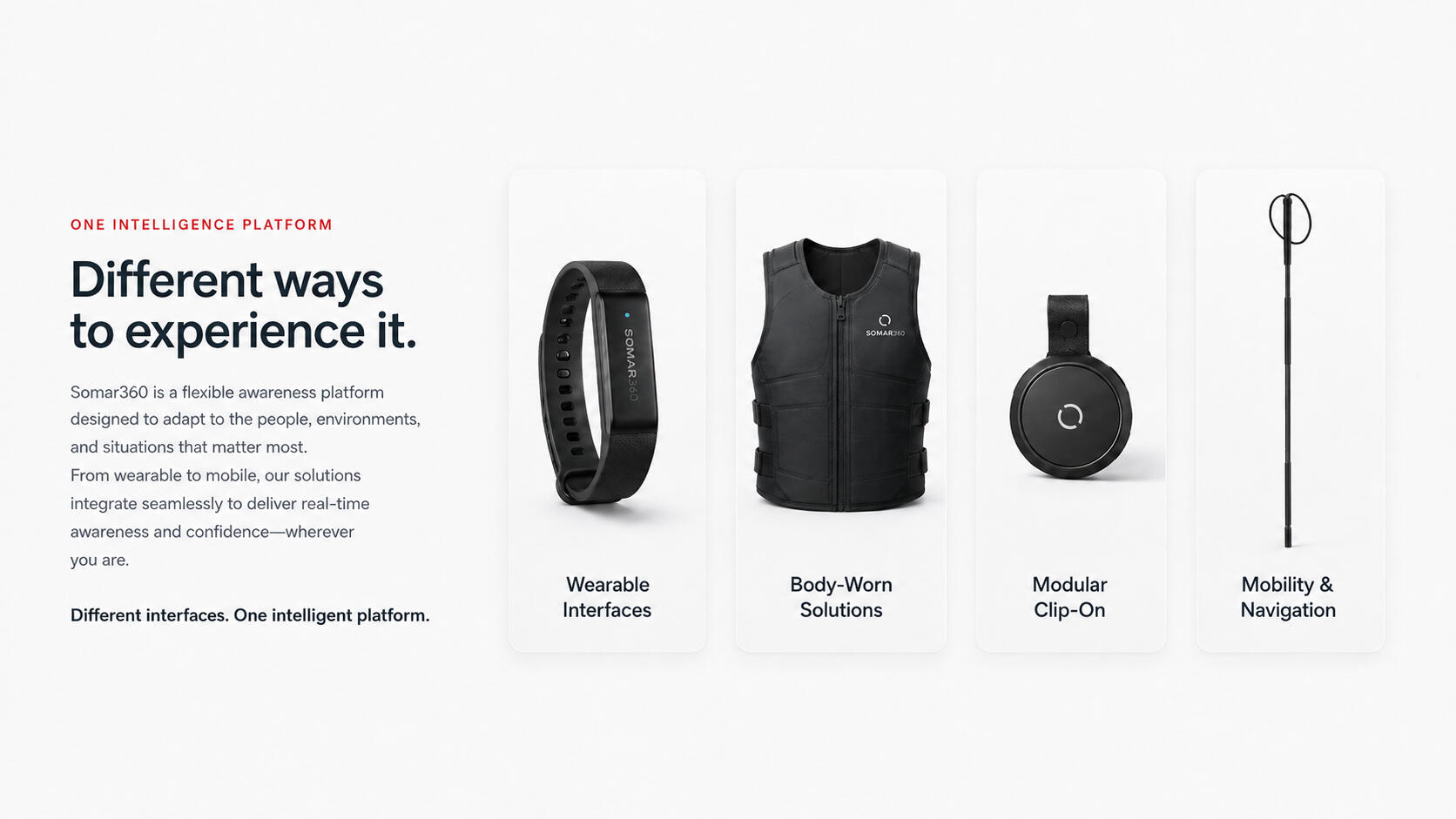
Somar360 should not be understood as simply a wristband company.A wrist-based wearable may become an important first form factor because it is familiar, discreet and practical for everyday use.But different environments may eventually require different hardware.The long-term platform could support multiple wearable configurations depending on the user, profession and application.The underlying Somar360 intelligence could remain consistent while the physical interface evolves.That could eventually include different wearable forms for:everyday consumers
mobility and navigation
professional environments
industrial applications
public safety
healthcare
specialized operational useThis is why Somar360 is being built as a platform, not merely a single device.The wearable is how someone experiences Somar360.The intelligence behind it is the larger company.
Who Could Somar360 Serve?
The potential market for spatial intelligence extends across many populations and industries.Everyday ConsumersPeople walking through cities, commuting, traveling, shopping or moving through busy environments could benefit from an additional layer of awareness.Runners, Cyclists and Active UsersPeople exercising outdoors often divide their attention between movement, music, navigation and environmental safety.Somar360 could eventually help communicate relevant activity around them while allowing them to remain focused on what they are doing.People Using Headphones or EarbudsModern life increasingly places people inside digital audio environments while they move through the physical world.Spatial intelligence could help reconnect users with important surrounding events without requiring them to abandon their audio experience.Navigation and MobilitySomar360 could support screen-free navigation using directional haptic guidance, allowing users to receive information through touch instead of repeatedly looking at a phone.AccessibilityFor people who are Deaf or hard of hearing, environmental sound and directional awareness could provide another way to understand events that may otherwise require constant visual monitoring.For people who are blind or have low vision, future spatial and object-awareness capabilities could potentially provide additional information about movement, obstacles and surrounding activity.Accessibility remains an important application of Somar360, but it is one part of a broader spatial intelligence platform.Public Safety and First RespondersPolice officers, firefighters, emergency personnel and other professionals frequently operate in environments where attention is divided and situational information matters.Future professional versions of Somar360 could explore how spatial intelligence, directional awareness and hands-free haptic communication might support those environments.Industrial and Workplace ApplicationsWorkers in transportation, logistics, manufacturing, construction and other complex environments may benefit from technology capable of recognizing and prioritizing relevant activity around them.Healthcare and CaregivingFuture applications could explore how environmental intelligence, mobility support and wearable awareness may contribute to healthcare, caregiving and independent living.Defense and Specialized OperationsLonger term, spatial intelligence may have applications in environments where operators need information while keeping their hands, eyes and attention available for other tasks.These markets would require significant additional research, validation, development and potentially different hardware configurations.But they demonstrate why the Somar360 opportunity extends far beyond one initial use case.
Why Somar360 Was Created
Somar360 began with lived experience.As someone with hearing loss, I have spent much of my life compensating for information I cannot always hear by visually monitoring the world around me.Looking behind me.Watching movement.Reading people's expressions.Constantly checking my environment.That experience led to a question:Why should understanding what is happening around us depend entirely on whether we happen to see or hear it?What began as a personal problem eventually revealed a much larger opportunity.Everyone has limits to attention.Everyone misses information.Everyone operates in environments where sight and hearing can become overloaded, distracted or unavailable.The insight behind Somar360 became bigger than creating something specifically for me.It became:Can technology create an additional sense of environmental awareness for humans?That is the problem Somar360 is now pursuing.
The Long-Term Vision
Somar360's long-term ambition is to build a new category of personal technology.Not another smartwatch.Not another notification device.Not another app demanding more screen time.But a platform capable of understanding the physical environment and translating meaningful information into an intuitive experience for the human wearing it.As sensing technology improves, AI becomes more capable, wearable computing becomes smaller and haptic interfaces become more sophisticated, the relationship between humans and computers can move beyond traditional screens.Somar360 is being built around the belief that the next generation of personal computing will not only answer questions about the digital world.It will help people understand the physical world happening around them in real time.Somar360 = Spatial Intelligence for Humans.
The Vision
Spatial Intelligence for HumansTechnology has become extraordinarily good at helping people understand the digital world.We can ask questions, search billions of pieces of information, navigate cities, communicate instantly, monitor our health, analyze data, and access artificial intelligence from almost anywhere.But there is still a gap.Technology understands our screens far better than it understands the physical world immediately surrounding us.The next evolution of personal technology should not require people to constantly look down at a device to understand what is happening around them.Somar360 is being built around a different future.A future where technology can perceive the physical environment, interpret what is happening in real time, understand what matters to the individual, and communicate that information intuitively without demanding more of their visual attention.That is the long-term vision behind:Spatial Intelligence for Humans.
Intelligence Beyond the Screen
For decades, personal computing has primarily communicated through screens.Phones became more powerful.Displays became smaller.Smartwatches moved information from our pockets to our wrists.But the interaction remained largely the same:Look at something to understand something.Somar360 is exploring what comes next.Instead of asking humans to continuously adapt their attention to technology, Somar360 is being designed around technology adapting to the human.The system could observe relevant activity in the surrounding environment, understand its spatial relationship to the user, determine whether it deserves attention, and communicate that information through an intuitive physical interface.The goal is not to eliminate screens.It is to reduce our dependence on them when the information we need is happening in the physical world around us.
From Wearable Computing to Wearable Intelligence
Most wearables today primarily measure the person wearing them.They track:heart rate
steps
sleep
exercise
notifications
locationSomar360 is pursuing a different dimension of wearable computing.Understanding the environment surrounding the person.What is nearby?What is approaching?Where did something happen?Is something moving toward or away from the user?Which environmental event actually matters?Does the user need to respond?This changes the wearable from something that simply reports information into something that can potentially help interpret the physical world.Somar360's long-term ambition is to move from:Wearable devicetoWearable intelligence.
A Personal Spatial Intelligence Layer
The future Somar360 platform is envisioned as a personalized intelligence layer operating between a person and the environment around them.That layer could combine information from multiple sources, including environmental sensing, sound intelligence, spatial positioning, movement detection, navigation systems, connected devices, contextual AI, and eventually other sensor technologies.But collecting information is not the ultimate objective.The intelligence comes from deciding:What matters right now?Two people standing in the same location may need completely different information.A commuter may care about navigation and approaching traffic.A runner may care about vehicles, cyclists, route guidance, and nearby movement.A professional working in a high-risk environment may prioritize warnings, people, equipment, and directional events.A person navigating with sensory limitations may prioritize environmental information they cannot easily perceive through traditional senses.Somar360 is being designed around the idea that spatial intelligence should become increasingly personal, contextual, adaptive, and situational.
An Intelligence System That Learns the Individual
The long-term Somar360 experience should not behave identically for every person.It should learn.Over time, the platform could understand:which information a user cares about
which alerts they routinely ignore
which environments require greater sensitivity
which haptic patterns they understand most naturally
how much information they prefer
what types of events deserve immediate attention
how their needs change depending on location or activityA user walking through an airport may need a different intelligence profile from the same person running outdoors.Driving may require another.Working may require another.Traveling through an unfamiliar city may require another.The vision is for Somar360 to eventually understand not only what is happening around the user, but also what matters to this particular user in this particular moment.
Building a Haptic Language for the Physical World
Vibration today usually means one thing:Something happened.Your phone vibrates.Your watch vibrates.A notification arrives.But touch is capable of communicating far more information than a generic buzz.Somar360 envisions a future where haptics can become a meaningful communication language.Direction could have a pattern.Urgency could have a pattern.Proximity could have a pattern.Movement could have a pattern.Navigation could have a pattern.Different categories of environmental events could become recognizable through different tactile experiences.Eventually, users should not need to consciously translate every haptic cue.They should simply understand it.Just as humans learn to recognize certain sounds or visual symbols instantly, the Somar360 vision is for spatial haptic communication to become intuitive through use.This creates the possibility of an entirely different human-computer interface.
One Intelligence Platform, Many Forms
Somar360's future is not tied to one piece of hardware.The wrist may be an important starting point because it is practical, familiar, and accessible for everyday use.But different environments will require different interfaces.Future forms could potentially include:wrist-based wearables
integrated apparel
specialized professional wearables
mobility-oriented devices
connected safety equipment
other body-worn interfaces not yet developedThe physical device may change.The intelligence layer remains.That is an important part of the vision:Somar360 is not ultimately the wearable. Somar360 is the intelligence that can live across wearables.
From Everyday Awareness to Specialized Intelligence
Spatial intelligence has the potential to serve a broad range of environments.Everyday LifeHelping people understand relevant events while walking, commuting, traveling, shopping, exercising, or moving through crowded environments.MobilityProviding screen-free navigation and directional awareness.Active LifestylesSupporting runners, cyclists, outdoor users, and people wearing headphones who want to remain connected to their surroundings.AccessibilityCreating additional ways for people to perceive information that may not be readily available through sight or hearing alone.WorkplacesSupporting awareness in industrial, logistics, transportation, construction, manufacturing, and other operational environments.Healthcare and Independent LivingExploring how environmental and spatial intelligence may support mobility, caregiving, safety, and independent living.Public Safety and Emergency ResponseExploring hands-free situational intelligence for professionals working in complex or high-pressure environments.Specialized and Mission-Critical EnvironmentsLonger-term applications may emerge wherever people need information about the physical environment while preserving their hands, eyes, hearing, or attention for other responsibilities.Not every one of these applications will require the same Somar360 device.But they can potentially share the same intelligence foundation.
A Platform That Expands With Technology
Somar360's capabilities should evolve as the technologies around it evolve.Advancements in:Artificial intelligencecould improve contextual understanding and prioritization.Computer visioncould increase object and movement awareness.Edge computingcould allow more intelligence to operate locally and quickly.Sensor technologycould make environmental perception more accurate and energy efficient.Haptic technologycould create increasingly expressive tactile communication.Wearable computingcould make devices smaller, lighter, more powerful, and more seamlessly integrated into everyday life.Somar360 is being architected around a long-term platform philosophy so that the company can continue incorporating new sensing, intelligence, and interface technologies as they mature.The product should evolve without requiring the vision to change.
The Future We Are Building Toward
Imagine a person moving through the world without constantly checking what is behind them.Imagine navigation that does not require staring at a phone.Imagine environmental information reaching someone through touch before they ever think to search for it.Imagine AI that understands not just the information on a screen, but the physical situation unfolding around the person using it.Imagine technology that does not constantly compete for human attention, but quietly enhances it.That is the future Somar360 is working toward.The goal is not to make humans more dependent on technology.The goal is to make technology better at supporting the way humans naturally move through the world.
The Long-Term Ambition
Somar360 is beginning with wearable spatial intelligence.But the larger ambition is to help establish an entirely new category of personal computing.A category where technology understands:What is happening.Where it is happening.Whether it matters.What the individual may need to know next.And then communicates that intelligence through the most appropriate interface for the situation.Somar360's long-term success would mean spatial intelligence becomes something people no longer think about as a separate technology.It simply becomes another layer of how humans understand and interact with the world.Somar360
Spatial Intelligence for Humans.
Get Involved
Help Shape the Future of Spatial IntelligenceSomar360 is still early, and some of the most important decisions are being shaped now.Building spatial intelligence for humans will require more than technology alone. It will require real-world testing, diverse perspectives, technical expertise, industry partnerships, research, and people willing to challenge assumptions about how humans should interact with technology.Whether you are interested in testing Somar360, exploring a partnership, contributing expertise, or supporting the company as an investor, there are several ways to get involved.Become an Early TesterHelp us build something people can actually understand, trust, and use.Somar360 is being designed around real human environments, not just laboratory conditions.Future testing will help explore questions such as:Which environmental events are actually useful to know about?
Which alerts become distracting?
What haptic patterns are easiest to understand?
How should direction, proximity, movement, and urgency feel?
How comfortable should the wearable be during everyday use?
How should Somar360 behave differently across environments?We are interested in hearing from people across a variety of experiences and lifestyles, including commuters, runners, travelers, people who frequently use headphones, people with sensory disabilities, active professionals, and anyone interested in the future of wearable intelligence.Explore a Pilot or Strategic PartnershipSomar360's potential applications extend across multiple industries and environments.We are interested in conversations with organizations exploring areas such as:Mobility and transportation
Consumer wearables
Navigation
Public safety
Healthcare
Accessibility
Industrial and workplace safety
Logistics and transportation environments
Smart environments and connected infrastructurePartnerships could eventually include product testing, use-case validation, research collaboration, pilot programs, technology integration, or commercialization opportunities.Because Somar360 is still in development, early partnerships are primarily about understanding the problem, validating use cases, and identifying environments where spatial intelligence could create meaningful value.Technology & Development Partners
Help Build the Intelligence Behind Somar360Somar360 sits at the intersection of multiple technologies.The platform will require expertise across areas such as:artificial intelligence and machine learning
environmental perception
spatial sensing
embedded systems
wearable hardware
haptic technology
edge computing
mobile and cloud software
sensor integration
power and battery optimization
prototyping
manufacturing
testing and validationWe are building relationships with experienced technology companies, engineering teams, researchers, suppliers, and development partners capable of helping translate the Somar360 vision into reliable real-world technology.Investors
Back a New Category of Personal IntelligenceSomar360 is being built around the belief that wearable technology can move beyond fitness tracking, notifications, and screens.The opportunity is to build an intelligence layer capable of understanding the physical environment around a person and communicating meaningful information in real time.Somar360 sits at the intersection of:Artificial Intelligence
Wearable Computing
Spatial Intelligence
Human-Computer Interaction
Haptics
Environmental PerceptionAs the company advances through validation, prototype development, testing, and commercialization, we welcome conversations with investors who understand long-term platform opportunities and category creation.Researchers, Advisors & Subject-Matter Experts
Challenge the Thinking With UsSpatial intelligence touches many fields, and Somar360 should not be built inside an engineering bubble.We welcome conversations with researchers and experts in areas including:human factors
haptics
wearable computing
accessibility
mobility
AI and machine perception
behavioral science
public safety
industrial safety
navigation
human-computer interaction
sensory substitution and augmentationStrong products are built by testing assumptions early and learning from people who understand the environments in which the technology will eventually operate.Join the Somar360 CommunityYou don't have to be an investor, engineer, or future customer to participate.If you're interested in AI, wearables, spatial computing, human-centered technology, accessibility, or the future of human awareness, follow the journey as Somar360 evolves from concept to real-world technology.We'll share progress, lessons, product thinking, milestones, opportunities to participate, and ways to help shape what comes next.
We're Building This With the World, Not in Isolation
Somar360's ambition is large, but the philosophy behind building it is simple:Listen. Test. Learn. Improve.The people who eventually use Somar360 should have a voice in how it is built.The organizations that understand the environments it may operate in should help challenge its assumptions.The engineers building the technology should understand the human problem behind it.And the investors supporting the company should understand that the opportunity is larger than a single device.If you see a place for yourself in that journey, we'd like to hear from you.Get Involved With Somar360Fill out our form by clicking Join the Community
Contact
Let’s ConnectHave a question about Somar360 or want to start a conversation? We’d love to hear from you.Somar360 welcomes inquiries from individuals, organizations, media, researchers, industry professionals, and others interested in learning more about what we’re building.For general questions, media or speaking inquiries, business discussions, research conversations, or other matters, please reach out below.If you’re interested in testing Somar360, exploring a partnership, contributing expertise, or discussing investment opportunities, please visit our Get Involved page.
Building the future of human awareness starts with conversation.Somar360Spatial Intelligence for Humans
My Story: Why I’m Building Somar360
Somar360 did not begin with a market report, a technology trend, or an idea I thought would make a good startup.It began with the way I learned to move through the world.I have lived with hearing loss for most of my life, and because of that, awareness has never been something I could take for granted.I learned to watch.To scan.To pay attention to movement.To look at faces for information.To turn around and check what was happening behind me.To notice changes in an environment that other people might never consciously think about.When you cannot rely completely on sound to tell you what is happening around you, you learn to collect information in other ways.And over time, that becomes exhausting.There is a mental load that comes with constantly trying to fill in pieces of information that other people may receive automatically.Did someone call for me?Did something happen behind me?Where did that sound come from?Is something approaching?Did everyone else notice something that I missed?Is there something happening around me that I should be paying attention to?You learn to compensate.You become more observant. You anticipate. You watch people's reactions. You look for visual clues. You repeatedly check your surroundings because sometimes that is the only way to feel certain that you understand what is happening.After doing it for long enough, it becomes almost automatic.But automatic does not mean effortless.I Started Asking a Different QuestionFor a long time, I thought about this as something I simply had to adapt to.Then eventually, I started questioning the assumption itself.Why should understanding our surroundings depend so heavily on constantly looking, listening, checking, and interpreting everything ourselves?We have incredibly powerful technology in our pockets and on our bodies.Our devices can recognize speech, identify images, map entire cities, understand patterns, detect movement, analyze enormous amounts of information, and increasingly understand the world around them.Yet humans are still expected to manually piece together much of what is happening in the physical environment around us.That realization stayed with me.And eventually I began asking:What if technology could help us understand the space around us?Not by demanding that we stare at another screen.Not by flooding us with more notifications.Not by vibrating every time something happens.But by actually understanding the environment first.What is happening?Where is it happening?Is it approaching or moving away?How close is it?Does it matter?Does this particular person need to know about it?And if they do, what is the most intuitive way to communicate that information?That question became the foundation of Somar360.The Problem Became Bigger Than My Own ExperienceThe idea may have started with my hearing loss, but I quickly realized the underlying problem was much larger than hearing.Human attention is limited.We walk through crowded streets while looking at phones.We run or exercise while wearing headphones.We navigate unfamiliar places.We commute through busy stations.We work in environments where multiple things are happening at once.First responders operate in situations where seconds and attention matter.People with different sensory abilities experience the same physical environment in completely different ways.And increasingly, we live surrounded by devices that collect enormous amounts of information while still leaving the human being responsible for deciding what actually matters.That is where my thinking changed.I stopped asking:"How can technology help someone with hearing loss know that something happened?"And started asking:"How can technology help a human being understand what is happening around them?"That is a fundamentally bigger question.And it is the question Somar360 is being built to explore.From Awareness to Spatial IntelligenceMy vision for Somar360 is not simply a wearable that detects things.It is a spatial intelligence platform designed to eventually create a new communication layer between a person and the physical world around them.The system could combine artificial intelligence, environmental sensing, spatial awareness, contextual understanding, and wearable haptic feedback.The goal is not to communicate everything.That would create another form of information overload.The goal is to understand enough about the environment to determine what deserves the person's attention.Then communicate that information in a way that can become intuitive.A person should not have to stop and decode a complicated vibration pattern every time something happens.Over time, directional and contextual haptic signals could become something the brain learns almost instinctively.Something approaching from behind might feel different from something happening to the left.Urgency might feel different from ordinary awareness.Navigation might feel different from an environmental alert.The technology disappears into the experience.That is the direction I want Somar360 to move toward.What This Could Mean in the Real WorldImagine a runner wearing headphones who can feel that a bicycle or vehicle is approaching from behind.A commuter moving through a crowded station who receives awareness of relevant movement without constantly checking a screen.A traveler navigating an unfamiliar environment through subtle directional guidance.A person with hearing loss receiving spatial information about important sounds around them.A person with low vision gaining another channel for understanding obstacles, movement, or direction.A worker becoming aware of a developing hazard.A first responder receiving prioritized environmental information while keeping their eyes and attention on the situation in front of them.These are very different people.But underneath each use case is the same problem:There is important information in the environment that the person needs to understand.Somar360's job is to help bridge the gap between the physical world and human awareness.Why This Matters to MeI know what it feels like to wish you had another layer of awareness.I know what it feels like to compensate constantly because one source of information is incomplete.I know the habit of scanning your surroundings because you do not want to miss something important.And I know how easy it is for that behavior to become so normal that you stop thinking about how much effort it actually requires.That experience gave me the problem.But I do not want my experience to limit the size of the solution.I want it to inform the solution.There is an important difference.Somar360 is not being built only for people who experience the world the way I do.It is being built from an insight I gained because I experience the world the way I do.Sometimes the person who experiences a limitation most intensely can see an opportunity the rest of the world has learned to accept.That is what Somar360 represents to me.Building What I Once Wished ExistedThere is something deeply personal about building technology you once wished someone else had already created.But there is also something exciting about realizing that the solution could become much larger than the problem that originally inspired it.I am still at the beginning.There are assumptions to test.There are technologies to build.There are engineering problems to solve.There are users to listen to.There are things about Somar360 today that will undoubtedly change as we learn.I want that.Because I do not want to build Somar360 around my assumptions.I want to build it around what actually works for people in the real world.But the reason I started has not changed.I want technology to help people feel more connected to the physical world around them, not more distracted from it.I want awareness to become more intuitive.I want information to reach people in ways that do not always require another screen.And I want to explore what becomes possible when artificial intelligence does not just live inside our devices, but begins helping us understand the space we physically occupy.That is the future I am building toward.Somar360
Spatial Intelligence for Humans.
Frequently Asked Questions
What is Somar360?
Somar360 is a spatial intelligence platform being developed to help people understand what is happening around them, where it is happening, whether it matters, and how to respond.Is Somar360 available today?
Not yet. Somar360 is currently in the early development and validation stage.Is Somar360 only for people with disabilities?
No. The vision is much broader. Somar360 is being designed as a human-awareness platform with potential applications for everyday users, commuters, runners, travelers, people with sensory disabilities, workers, first responders, and other environments where spatial awareness matters.How will Somar360 work?
The long-term system is intended to combine AI, environmental sensing, spatial intelligence, contextual prioritization, and intuitive haptic feedback to communicate relevant information without requiring constant attention to a screen.What does “Spatial Intelligence for Humans” mean?
It means using technology to help people better understand and interact with the physical environment around them.Can I become a tester?
Yes. Interested early users can join the Somar360 community and express interest in future testing opportunities.Can organizations partner with Somar360?
Somar360 welcomes conversations with researchers, industry partners, technology teams, organizations, and others interested in helping develop or validate the platform.Is Somar360 seeking investment?
Somar360 is an early-stage company and is open to appropriate conversations with investors and strategic partners.